01
Science
The history and the theory. From Aryabhata's rotating Earth to black holes, exoplanets and gravitational waves, the universe explained in language anyone can follow.
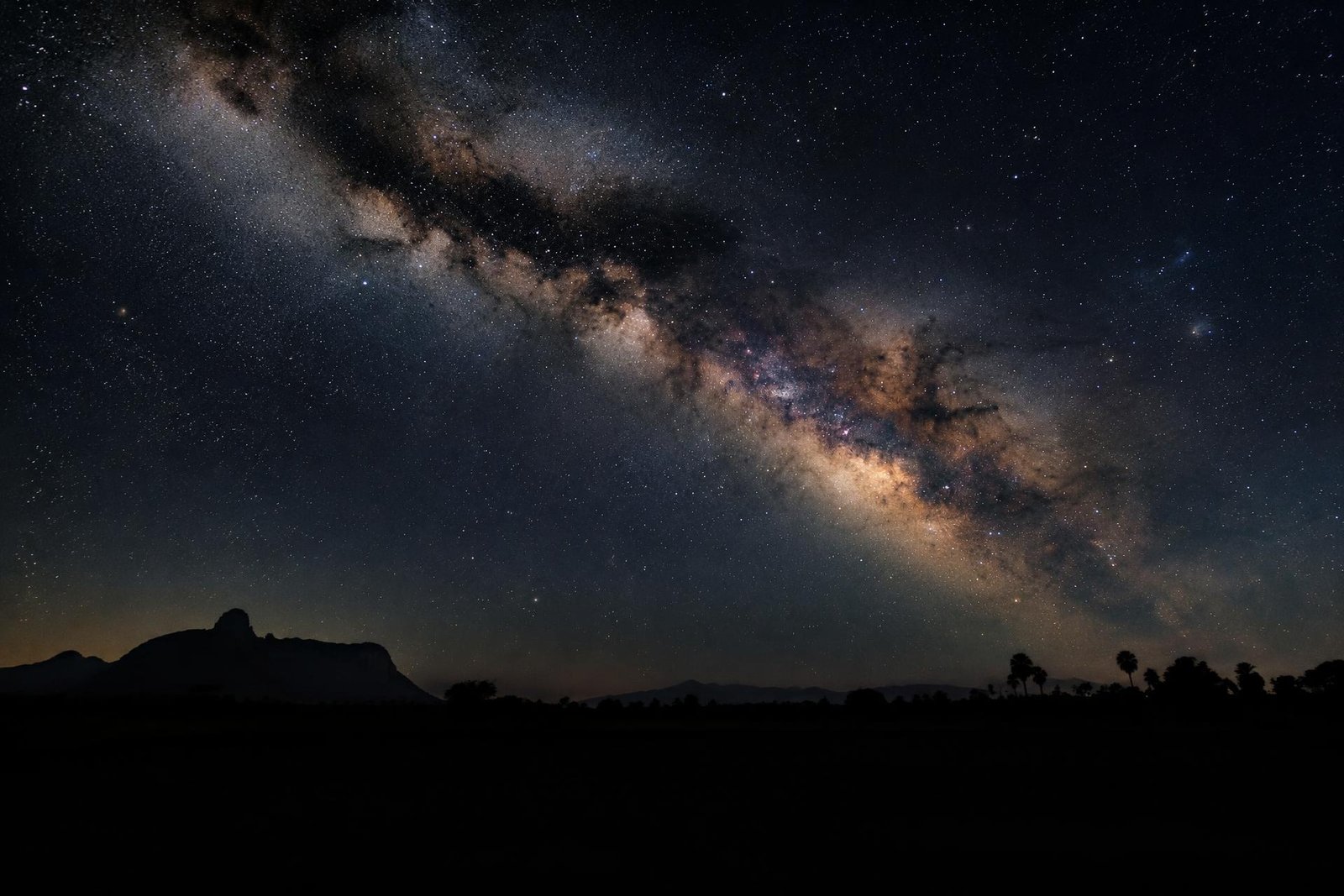
Science · Stories · Stars
AKASHAM. In Sanskrit, आकाशम्, the infinite expanse that holds the stars. India's love affair with the cosmos, told through science, stories and stargazing for students, parents, schools and everyone who has ever looked up.
01·The Meaning of Ākāśam
For thousands of years, humanity has looked upward and asked questions that shaped science, philosophy, mythology and imagination. We live on a small planet, orbiting an ordinary star, in one galaxy among billions. Yet we dare to ask the biggest questions. About time. About life. About light. About existence. About the universe itself.
AKASHAM exists for everyone who has ever looked up and wondered.
02·Science / Stories / Stars
Science for the mind, stories for the imagination, stars for the senses. Three doors into the same cosmos, and every one of them leads back to our goal.
01
The history and the theory. From Aryabhata's rotating Earth to black holes, exoplanets and gravitational waves, the universe explained in language anyone can follow.
02
The folktales and the myths. Nakshatra legends, Rahu and Ketu, constellation tales from every culture, retold for today's children.
03
Astrophotography and space mapping. Telescopes, night-sky sessions and image capture that let anyone chart the sky for themselves.
03·About AKASHAM
The story of the cosmos is the greatest story ever told. It holds science, history, mythology, technology, philosophy, mathematics, imagination and the future of humanity in a single narrative.
Our goal: to bridge India's ancient sky wisdom with its modern space age, and to make astrophysics accessible, aspirational and emotionally real for the next generation.
04·Our Roots
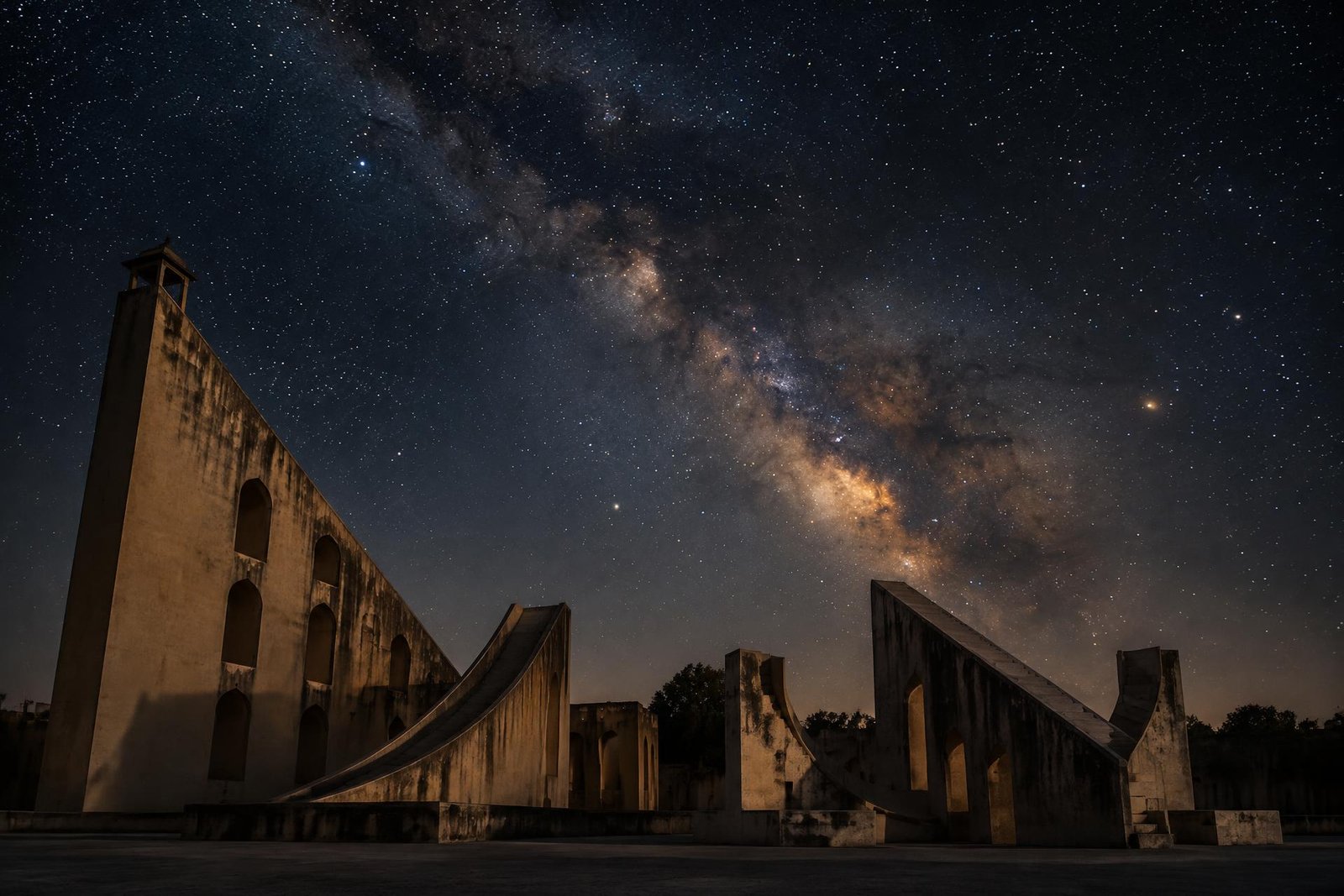
Jantar Mantar · Stone instruments that still keep time
This legacy is not a museum piece. It is the ground AKASHAM stands on. When a student meets nakshatras and Chandrayaan-3 in the same story, the gap between ancient wonder and modern science begins to close. That bridge is our goal.
Ancient
27 lunar mansions mapped across the ecliptic, guiding festivals, navigation and agriculture for millennia.
499 CE
Earth rotates on its axis, eclipses explained by shadow, the value of π to four decimal places.
6th c. CE
The Brihat Samhita, an encyclopedic record of sky observation, weather and planetary motion.
1150 CE
The Siddhanta Shiromani: planetary longitudes, eclipses and early ideas approaching calculus.
1724
Maharaja Jai Singh II's massive masonry observatories, instruments of stone that still keep time.
1969
From sounding rockets launched on bicycle carriers to Mangalyaan, Aditya-L1 and beyond.
1988
A national research network: IUCAA, IIA, TIFR, IISc and planetariums across the country.
2023
India becomes the first nation to land near the Moon's south pole.
05·Mythologies of the Sky
Across the world, humans looked at the same sky and created different stories. Each of these will unfold into a folktale retold, the constellation or planet behind it, and the science of what people actually saw.
Nakshatras · Sapta Rishi · Rahu & Ketu · Surya · Chandra
The 27 lunar mansions and the shadow-snakes that explain eclipses.
Orion · Andromeda · Cassiopeia
Hunters, queens and chained princesses fixed forever in the constellations.
Ra · Nut · Sirius
A sky-goddess swallowing the sun each night; Sirius heralding the Nile flood.
Chang'e · Celestial Dragons
The moon goddess and dragons that devoured the sun during eclipses.
Ishtar · Venus
The earliest written records of the sky, and Venus as the queen of heaven.
Tishtrya
A radiant star-spirit of Sirius, battling drought across the heavens.
Venus Cycles
Cities aligned to Venus's 584-day dance, astronomy as architecture.
06·Cosmic Calendar
To show you exactly how the calendar will look, we have filled it with real events from the recent past. The live version will list upcoming events, answer "Can I see this from my city?" and add viewing guides, student activities and reminders.
Sample view
Dummy layout, built with historical events
Aug 12, 2025
Binoculars optional
Activity: Track two planets closing in on each other, night by night.
Sep 7, 2025
Naked-eye safe
Activity: Sketch the Moon's colour as Earth's shadow crosses it.
Sep 22, 2025
Daytime observation
Activity: Measure shadows at noon: day equals night everywhere.
Nov 5, 2025
Naked-eye safe
Activity: Photograph the year's closest, brightest full Moon.
Dec 14, 2025
No telescope needed
Activity: Count meteors per hour and keep a sky journal.
Feb 28, 2026
Community
Activity: Celebrate the Raman Effect; run a sky-watch at school.
Monthly view · City filters · Reminders, all coming with the full platform
07·Tonight's Sky
A real-time sky companion, tuned to your city's sky, your horizon and your weather, keeping the experience alive every single day.
New Moon
3% illuminated · Moon age 28 days
Live tonight
08·The Festival
First edition · December 2026 (tentative)
A three-day cosmic festival of talks, telescope village, planetarium experiences, stargazing, student workshops, mythology sessions, films, AI experiences, astrophotography and scientist interactions. Built for schools, parents and the endlessly curious. Venue and final dates will be announced once locked in.
A roadmap, not a menu: these experiences are our goal, and they will come to life over time, not all at once.
09·Students & Parents
For Students
For Parents
10·Contact
Questions about the festival, schools, partnerships, volunteering or anything else under the sky? Call or write, we reply personally.
AKASHAM doesn't simply tell people about the universe. It makes them look up.